Whale stablecoin loops, re-read from the chain
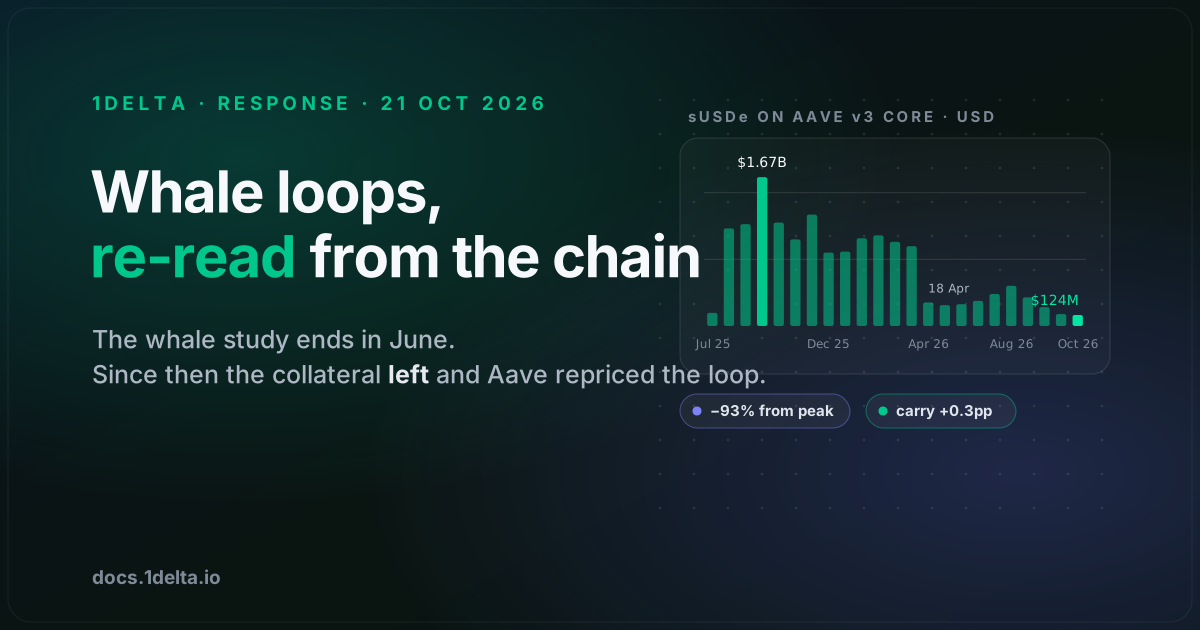
A University of Zurich study finds whales looping sUSDe, sUSDS and syrupUSDC at 5–8x on Aave and Morpho, with thin health factors and no liquidations. We read the same markets on 21 October: sUSDe on Aave Core is down to $124M from $1.67B, the loop's carry against USDC cleared half a point in three of the last sixteen months, and Aave's risk stewards moved the USDe base rate from 0% to 6.3% in two weeks. Plus the venues, oracles and exits the study leaves out.

Krzysztof Gogol, Dawid Rymarczyk and Igli Kristo published How Whales Loop Yield-Bearing Stablecoins, Step by Step on 21 October. It draws on a University of Zurich study by Kristo, Rymarczyk, Claudio Tessone and Gogol that replays every supply, withdraw, borrow and repay on Aave v3 and Morpho Blue for sUSDe, sUSDS and syrupUSDC between March 2024 and June 2026, with a holder snapshot on 14 July 2026.
Their findings, in their numbers: 26 Aave borrowers in the 5–8x band hold $275.2M of sUSDe and 48 above 8x hold $118.9M, while 83.7% of borrowers sit at 1.1x or less. Leverage changed on 7.2% of the 2,506 looper-days they observed. On Aave, 13.1% of the positions with a health factor below 1.05 hold 97.0% of that band's collateral; on Morpho, 22.0% hold 93.1%. The lowest health factor they saw was 0.998. No position in the sample was liquidated.
The study is careful and the data work is real. It also stops at 27 June, and these markets have moved since. We read Aave v3 Core, Morpho Blue and the oracles behind both on 21 October 2026, 11:00 UTC (Ethereum block 26,240,463), and three things stand out:
- The collateral left. sUSDe supplied to Aave v3 Core on Ethereum was $124M at the snapshot. By the same read it was $360M in the week of the study's snapshot and $1.67B at its peak on 26 September 2025.
- The carry on the Aave Core USDC loop was thin. Since July 2025, sUSDe's yield has exceeded Aave Core's USDC borrow rate by more than half a point in three months out of sixteen, all of them in 2025. Other venues and debt assets did better, and the venue table below shows where.
- Aave has priced USDe-denominated loops out. Between 5August and 9 September, Aave's risk stewards raised the USDe base borrow rate from 0% to 6%, anchored to sUSDe's own yield, and recommended 6.3% on 11 September. At the snapshot the deployed rate model has a 6.6% base; the reserve lends at 6.61% with 4.7% utilisation. This hits loops that borrow USDe. The sUSDe e-mode on Core borrows USDC and USDT, and those loops are a carry question, taken up below.
The rest of this piece goes through the venues, the oracles, the exits and the strategies the study does not cover. Every figure is read from the chain or an API at the snapshot unless a source is named; contract addresses are listed at the end.
The collateral moved while the paper was in review
The study's Aave numbers come from a single snapshot. The aToken for sUSDe on Aave v3 Core, read every three weeks since July 2025 and valued at that day's sUSDe exchange rate, looks like this:
totalSupply of aEthsUSDe and convertToAssets on sUSDe at each block. Shaded: the two weeks in which the USDe base rate went from 0% to 6%.Three moves are worth dating.
April 2026. On 18 April an attacker released 116,500 rsETH through Kelp DAO's bridge without depositing anything and borrowed against it on Aave. Aave froze rsETH and took bad debt estimated at up to $230M by CoinDesk. Depositors pulled more than $5B in a day. sUSDe on Core went from 732M tokens on 3 April to 216M on 24 April, and total sUSDe supply from 2.88B to 1.81B. The incident did not touch sUSDe's backing, but it changed the liquidity the loops ran on. A loop at 8x in a market whose stablecoin side is being withdrawn is a loop whose borrow rate is about to spike, and the sampled USDC borrow rate on 24 April was 8.8%, USDT 13.9%.
The study's window. The snapshot on 14 July falls in the recovery: 290M sUSDe ($360M) on 17 July, 363M ($452M) on 7 August. The report gives $587.1M of sUSDe collateral backing stablecoin debt on Aave. We could not reconcile that with the Core aToken; the Prime instance held under 6M sUSDe at every read and the V4 Ethena market did not exist yet. The methodology section does not say which instances or wrappers are counted, so we leave the two numbers side by side and compare our October figure only with our own earlier reads, not with theirs.
September and October 2026. LlamaRisk, acting as Aave risk steward, raised the USDe base rate from 0.00% to 6.00% in six steps between 28 August and 9 September and recommended 6.30% on 11 September, with the base "anchored to Ethena's realized sUSDe yield" and reassessed weekly. Risk stewards change rate parameters within bounds that Aave governance has delegated to them, so each step is a steward action rather than a vote. At the snapshot, the interest-rate strategy for the Core USDe reserve returns a base of 6.60%, a first slope of 0.25% and a 90% optimal utilisation; with 4.7% of the reserve borrowed, the variable borrow rate is 6.61%, which is the base plus 0.25% times 4.7/90. So the deployed base has moved once more since the 11 September post, and the floor on borrowing USDe sits above what sUSDe pays. LlamaRisk's own table has USDe debt on Core falling from $450.4M on 28 August to $117.5M on 11 September; the variable debt token reads $12.1M at the snapshot against $255M supplied. sUSDe collateral on Core fell from $452M to $124M over the same weeks; the two series moved together, and we do not claim the first caused the second.
The base rate targets USDe debt, and the sUSDe e-mode on Core does not lend USDe at all: category 2, "sUSDe Stablecoins", allows USDC and USDT as debt and nothing else, at 90% LTV, 92% liquidation threshold and a 4% bonus. Outside e-mode, sUSDe has an LTV of zero. So the sUSDe loops the study describes on Aave Core are, by construction, sUSDe against USDC or USDT, and the base-rate change does not touch their debt. What it does touch is their carry.
The carry the loop actually earned
The report's yield table assumes a carry of +1.86 percentage points. Here is the monthly average of sUSDe's yield next to the Aave v3 Core borrow rate for the three debt assets, from July 2025 to 21 October 2026. sUSDe yield is DefiLlama's daily APY series; the borrow rates are each reserve's variable rate, an APR, read from the Pool contract every two days and averaged by month. The gap between APY and APR is a few basis points at these levels and does not change any sign in the table. October is month-to-date through the 21st.
Against USDC, the loop cleared half a point in July, August and September 2025 and in no month since. At 8x, a carry of +0.3 points is 2.4 points of extra yield on the equity before gas and slippage. A carry of −1.1 points, as in April 2026, is a levered loss.
Against USDe the picture is different, and it explains why USDe debt is the thing Aave just repriced. From November 2025 to March 2026 and again from June to August, borrowing USDe cost 0.6 to 1.3 points less than sUSDe paid. That carry belonged to the PT e-modes: Core lists five "PT-sUSDe / USDe" categories at 92% LTV, and USDe is what the Plasma deployment's reserve lends. It is the loop the base rate now puts at −1.7 points.
The study reads the whales' calm as diligence. Part of it may be a different arithmetic: a position that costs more to adjust than the carry earns in a month gets adjusted once. We have not costed the adjustments, so that is a reading, not a measurement.
Where the loops are today
The study covers Aave and Morpho on Ethereum. That is where the sUSDe loops were in 2025. At the snapshot the collateral sits in more places, and the biggest single venue for sUSDe is not on Ethereum. The table is what we read on 21 October, not a census of every chain; supplied figures count all deposits of the token in that venue, including deposits with no debt against them.
| venue | collateral | supplied | debt side | max LTV / LLTV | borrow rate |
|---|---|---|---|---|---|
| Aave v3, Plasma | sUSDe | $182.3M | |||
| Aave v3 Core, Ethereum | sUSDe | $123.7M | USDC, USDT | 90 / 92 | 4.48% / 4.08% |
| Aave v3 Core, Ethereum | syrupUSDT | $114.8M | USDC, USDT | 90 / 92 | 4.48% / 4.08% |
| Morpho, Ethereum | sUSDe | $116.6M | PYUSD (97%), DAI, USDtb | 86–91.5 | PYUSD 4.15% |
| Morpho, Ethereum | sUSDS | $70.5M | USDT | 96.5 | 2.75–2.93% |
| Morpho, Ethereum | syrupUSDC | $62.8M | PYUSD | 91.5 | 4.50% |
| Aave v3, Plasma | syrupUSDT | $57.3M | |||
| Kamino, Solana | syrupUSDC | $54.4M | USDC | ||
| Morpho, Ethereum | PT-sUSDS 26 Nov 2026 | $28.6M | USDC, USDT, USDS | 91.5 | 3.8–7.6% |
| Morpho, Ethereum | PT-sUSDe 26 Nov 2026 | $8.3M | USDC | 91.5 | 4.34% |
| Aave V4, Ethereum | sUSDe (Ethena market) | $4.3M | USDe, stables | ||
| Euler v2, Ethereum | sUSDe, syrupUSDC | $1.4M | USDC | ||
| Fluid, Ethereum | sUSDe, syrupUSDC | $0.8M | USDC, USDT |
Snapshot 21 October 2026, 11:00 UTC. Aave, Morpho, Euler and Fluid rows read through the 1delta API and Morpho's GraphQL API; Kamino from DefiLlama. Morpho rows sum every market with that collateral; the LLTV and rate shown are the largest market's. Blank cells are parameters we did not read.
Three things in that table are not in the study. Aave's deployment on Plasma, the USDT chain from our stablecoin-native chains piece, holds more sUSDe than Core does. Maple's USDT token on Aave Core, syrupUSDT, is almost twice the size of the syrupUSDC market the study measures on Morpho, with its own 90/92 e-mode. And Morpho's sUSDe loops are now PYUSD loops: $112.7M of the $116.6M of sUSDe on Morpho sits in the PYUSD market, not a USDC one, because that is where the debt was cheapest when they were opened.
The sUSDS row shows what Morpho is for. Sky's token pays 3.80% today and USDT on Morpho costs 2.75%, so the carry is +1.05 points at a 96.5% LLTV, where the largest position runs 11.8x. On Aave Core, USDT costs 4.08% and the same loop loses money. Whales do not stay on one venue because they like it; they stay where the debt is cheapest at the leverage they want.
Concentration, counted today
The study's concentration finding is the one that holds up best. We pulled every position with open debt in the four largest Morpho markets for these tokens (sUSDe/PYUSD and syrupUSDC/PYUSD at 91.5% LLTV, two sUSDS/USDT markets at 96.5%) from Morpho's API at the snapshot. Collateral and debt are the API's USD values, leverage is collateral divided by collateral minus debt, and the health factor is the API's, which is the market LLTV times collateral value over debt.
| market | positions | collateral | positions ≥ $1M | share of collateral | HF < 1.05 | largest position |
|---|---|---|---|---|---|---|
| sUSDe / PYUSD | 31 | $112.7M | 12 | 99% | 7 positions, $23.1M | $23.0M at 6.9x, HF 1.073 |
| sUSDS / USDT | 89 | $70.5M | 9 | 88% | 23 positions, $14.3M | $35.0M at 11.8x, HF 1.054 |
| syrupUSDC / PYUSD | 18 | $62.8M | 5 | 97% | 2 positions, $54.6M | $50.9M at 9.1x, HF 1.029 |
The syrupUSDC market is one address. It holds $50.9M of the market's $62.8M of collateral at 9.1x, with a health factor of 1.029, which at a 91.5% LLTV is 2.8% of collateral value from liquidation. The second-largest sUSDS position sits at 12.9x and 1.046. These are the "thin buffers" of the study, and they are still there.
The other side of concentration is who lends. Morpho markets are funded by curated vaults, and a vault that sees a single borrower at 9x with a health factor of 1.03 can cap its allocation or exit. The study treats the lender side as given. It is a decision someone makes every day.
What the oracle can and cannot do
The study's stress test says a 3–5% fall in sUSDe's price would raise liquidatable collateral on Aave from $40M to over $510M, and the report says this is because Aave and Morpho "use oracle-reported prices rather than a fixed peg". The scenario applies the price shock to the oracle directly. On Aave the oracle does not follow sUSDe's market price, so the question is what would have to move for the oracle to print 3% lower.
Aave's price source for sUSDe on Core describes itself, on chain, as "Capped sUSDe / USDT / USD". It reads today at $1.25271: the sUSDe exchange rate of 1.25411 times Chainlink's USDT/USD at $0.99888, with a cap on how fast the exchange rate may grow. USDe itself is priced as "Capped USDT/USD". That design went through governance in February 2025 after LlamaRisk showed that under a market feed, $263M of sUSDe collateral became liquidatable at a 2.6% USDe deviation, of which about $1M could be liquidated profitably (the ARFC). Under the USDT peg, liquidations begin at a USDT deviation of about 11%.
So on Aave, the two plain routes to a 3% lower sUSDe oracle are USDT trading at $0.97 or the sUSDe vault losing 3% of its assets. Secondary-market selling of USDe cannot do it. That cuts both ways: a capped exchange-rate oracle does not remove liquidation risk, it moves it. A loss inside the vault shows up in the oracle only when the exchange rate is written down, and until then the positions cannot be liquidated and the lenders carry the shortfall. On 10 October 2025 USDe printed $0.65 on Binance's order book during the largest liquidation day in the market's history; Chainlink's aggregated feed and every on-chain venue stayed near $1, Ethena redeemed about $2B in 24 hours, and Aave's sUSDe positions were untouched (21Shares).
Morpho is market by market. The sUSDe/PYUSD oracle multiplies the sUSDe exchange rate by Chainlink's USDe/USD feed and divides by PYUSD/USD, so it does see a USDe market move, if the aggregated feed moves. The sUSDe/DAI market at 86% has no feed at all: exchange rate only, USDe hardcoded to one DAI. sUSDS/USDT and syrupUSDC/PYUSD follow the first pattern, exchange rate times the underlying's feed. Which oracle a market uses is a parameter of the market, chosen by whoever created it, and the study's health factors mix all of them.
The report's line that "yield-bearing stablecoins rarely lose value" is true of the three it picked. In the same window, four others did not survive. Stream's xUSD went from $1 to $0.26 on 4 November 2025 after a $93M loss at an external manager; Elixir's deUSD, 65% backed by loans to Stream, went to about $0.015 two days later; Stables Labs' USDX broke below $0.60 the same week. Lending markets on Morpho, Euler and Silo priced xUSD at a hardcoded $1, so nothing liquidated and the lenders ate it; analysts traced about $285M of debt across the affected vaults (Pharos). Resolv's USR followed on 22 March 2026 when an attacker minted roughly 80M unbacked tokens and the Curve pool printed $0.025 (Yahoo Finance). Morpho's API still reported bad debt on the USR, deUSD and sdeUSD markets at the snapshot. The four failures are different kinds of event, an external-manager loss, exposure to that loss, a depeg and an unbacked mint, and four cases are not a rate. What they share is that the collateral assumption broke faster than any lending market repriced it. The whales' calm rests on the issuer.
Exits: cooldowns, queues and callbacks
The study scores exits by whether an address has ever used a flash loan: 18.5% of Aave whales, none of the Morpho whales. Two things about that.
Morpho Blue does not need an external flash loan to unwind. Its repay, supplyCollateral and withdrawCollateral calls take callbacks, and the protocol has a zero-fee flashLoan of its own, so a position can be closed in one transaction without a flash-loan event from another protocol ever appearing at the address. 1delta's composer takes its flash liquidity from the cheapest source available, and on Ethereum that is often Morpho's own. A metric that counts Aave-style flash loans will read Morpho loopers as having no atomic exit when the cheapest one is built into their protocol. That says the route exists; it does not say a given whale has tested it at its size.
The harder constraint is what you are selling. sUSDe's cooldownDuration read 86,400 seconds at the snapshot, one day. Ethena replaced the fixed seven-day cooldown with a variable one in March 2026 that steps between one, three, five and seven days depending on how USDe's backing is allocated (The Defiant), so one day is the reading of the moment, not a property of the token. Redemption is in any case not instant, so an atomic unwind sells sUSDe into DEX liquidity. syrupUSDC withdrawals go through Maple's queue: maxWithdraw on the syrupUSDC vault for the $50.9M position returned 0 at the snapshot. The whale at 9.1x and HF 1.029 cannot redeem its way out inside one block; it can only sell. The exit mechanism on the protocol side is solved. The exit on the asset side is a liquidity question the study does not ask, and it is the one that decides whether a liquidation at HF 1.00 is a 3% haircut or bad debt.
Strategies the study leaves out
The loop in the report is the simplest one. Most of the leverage on yield-bearing dollars in the last eighteen months was something else.
PT loops. When Chaos Labs sized Aave's Ethena exposure on 2 August 2025, a snapshot from a very different market, looped debt against PT tokens was $3.5B against $550M of sUSDe-against-stable loops (Chaos Labs). A PT fixes the yield, so the carry is known at entry, and the collateral converges to par at maturity. The cost is a second oracle problem, PT discount risk, which we wrote up when a 1% move in a PT price liquidated $36.1M on Morpho in August. Today PT-sUSDe for 26 November trades at a 4.96% implied yield and PT-sUSDS at 5.32%, against 4.79% and 3.80% on the floating tokens; the PT-sUSDS loop against USDS on Morpho carries about +1.5 points for five weeks.
Choosing the debt, not the venue. The same sUSDe collateral can borrow USDC at 4.48% on Aave, PYUSD at 4.15% on Morpho, or USDT at 2.75% on Morpho if you hold sUSDS instead. A debt swap moves an open position from one debt asset to another without closing it, and a migration moves it between protocols; both are single transactions on 1delta. The study's finding that leverage rarely changes may partly reflect that the borrowers who did reoptimise did it by moving, and a move shows up as a new position elsewhere, not as a leverage change. Testing that would mean tracing each whale across protocols and debt assets, which the study's per-market panel does not do and we have not done here.
Fixed-rate debt. The thing a looper fears most is the April 2026 pattern: the borrow rate doubling while the yield does not. Morpho Midnight on Base and Term Finance's auctions lend at a fixed rate to a fixed date, which turns the carry into a number. Coverage is still thin for these tokens, and it is where a cautious loop should look first. Our fixed-term lending piece has the mechanics.
Soft liquidation. Curve's LlamaLend accepts sUSDe and syrupUSDC against crvUSD and liquidates continuously across a price band instead of at a threshold. The markets are small today, $1.4M and $1.8M, but the design answers the study's concentration problem directly: a $50M position does not get sold in one block.
Other chains. Aave on Plasma and Kamino on Solana already hold more of this collateral than Euler and Fluid on Ethereum combined. Rates, oracles and e-modes differ per deployment, and the only way to compare them is a normalised read across all of them, which is what the 1delta API exists to do.
Four checks we would add
The report ends with a checklist (its text says six checks, the list has seven): carry, leverage, buffer, penalty, oracle, exit, concentration. These four are ours, from this read, not the authors'.
- Who can move the borrow rate, and how fast. Aave's risk stewards took the USDe base rate from 0% to 6% in thirteen days, under authority governance delegated to them in advance, with no vote on the individual steps. A loop's carry is a parameter someone else controls.
- What the oracle is made of. Exchange rate times a peg, exchange rate times a market feed, or exchange rate alone. Each fails differently, and the one that cannot be liquidated by a market move is also the one that cannot be liquidated by an issuer failure until someone updates it by hand.
- How the collateral is sold, not just how the loan is closed. A 24-hour cooldown or a withdrawal queue means the atomic exit is a DEX sale. Size the position against that pool's depth, not against the lending market's LLTV.
- How much of the carry is incentives. Ethena's liquid leverage programme went from 27% to 47% of USDe fee allocation between July and September (Ethena governance). Carry paid by a token programme ends when the programme does.
Running loops across these venues
The venue table above is two data calls: /v1/data/lending/pools for every market on a chain with its rates, caps and oracle description, and /v1/data/lending/pairs/leverage for every collateral-debt pair with its maximum leverage and liquidity. The write side is the same shape: /v1/actions/loop/leverage opens a loop in one transaction against Aave, Morpho, Euler, Fluid or any other lender the API indexes, /v1/actions/loop/close unwinds it, and debt-swap and migrate move it when the carry does. The API reference has every endpoint; the actions article walks through the request shape.
Contracts read, all on Ethereum at block 26,240,463 unless noted: Aave v3 Core Pool 0x87870Bca3F3fD6335C3F4ce8392D69350B4fA4E2 (e-mode categories, reserve data, rate strategy 0x9ec6f08190dea04a54f8afc53db96134e5e3fdfb); AaveOracle 0x54586bE62E3c3580375aE3723C145253060Ca0C2, sUSDe source 0x42bc86f2f08419280a99d8fbEa4672e7c30a86ec, USDe source 0xC26D4a1c46d884cfF6dE9800B6aE7A8Cf48B4Ff8; aEthsUSDe 0x4579a27af00a62c0eb156349f31b345c08386419 (history read every 150,000 blocks from 23,000,000 via an archive node); sUSDe 0x9D39A5DE30e57443BfF2A8307A4256c8797A3497 (convertToAssets, cooldownDuration); syrupUSDC 0x80ac24aA929eaF5013f6436cdA2a7ba190f5Cc0b (maxWithdraw); Morpho oracles 0xE6212D05cB5aF3C821Fef1C1A233a678724F9E7E (sUSDe/PYUSD), 0x1C7DBd66dF93594bA08af8e72c75Ba2004d92F9C (sUSDS/USDT), 0xc8043d248551Ed19B33cbc89dCCd69148c827039 (syrupUSDC/PYUSD), 0x5D916980D5Ae1737a8330Bf24dF812b2911Aae25 (sUSDe/DAI), each via BASE_VAULT, BASE_FEED_1, QUOTE_FEED_1.
Sources: How Whales Loop Yield-Bearing Stablecoins, Step by Step · Recursive Leverage in Yield-Bearing Stablecoins, UZH · LlamaRisk, IRM changes 11 September 2026 · Aave ARFC, sUSDe and USDe price feed update · Chaos Labs, Aave's growing exposure to Ethena · Ethena governance update, Q3 2026 · CoinDesk on the Kelp DAO exploit · 21Shares on the Binance USDe depeg · Pharos on Stream, Elixir and USDX · Yahoo Finance on Resolv USR · Morpho API · DefiLlama yields · 1delta API