Flying Tulip Lend: the lender that holds no cash
Flying Tulip runs lending as one cross-margin account per user, charges maintenance margin on debt as well as collateral, liquidates at a health factor of 1.25, and holds no cash at all: every deposit and every dollar behind ftUSD sits in a yield wrapper that puts it to work, including inside its own lending book. We read the deployed contracts on Ethereum, Sonic and BNB Chain, walk through how ftUSD is minted, staked and rate-limited, and compare the design with Aave V4 and Morpho.

Flying Tulip is Andre Cronje's protocol after Sonic. It raised money in a public sale that let buyers hand their FT back for the full amount they paid, and it plans a whole exchange on top: spot AMM, order book, futures, lending, insurance and a stablecoin. Two of those are live as lending infrastructure today, FT Lend and the ftUSD stablecoin, plus a leveraged-spot product called Trade that runs on the lending engine.
The book is small. On 22 October 2026 Flying Tulip's own API reports $18.40M supplied and $4.72M borrowed on Ethereum, $4.84M and $2.41M on Sonic, and $46k and $10k on BNB Chain: about $23.3M supplied and $7.1M borrowed in total. In August it was $14.0M and $1.5M, so the borrow side has grown close to fivefold in ten weeks.
What makes it worth reading is the design. Most lending protocols are a variation on Aave or on Morpho. FT Lend borrows its risk model from a centralised exchange's margin account, keeps no cash in the lending contract at all (every balance sits in a yield wrapper that is fully deployed, in one case back into FT Lend itself), and opens leverage through signed orders filled by anyone. We integrated it at 1delta, so the numbers here come from the deployed contracts rather than the docs, and in a few places the two disagree. Every balance, rate and price is a snapshot at the block stated next to it, and the annualised figures are what those snapshots imply, not forecasts.
The account is the market
Aave V3 keeps one pool per asset and a list of collateral factors. Morpho Blue keeps one market per collateral and loan pair. FT Lend keeps one account per user per chain that holds every deposit and every debt together, and it prices risk with a maintenance margin per asset, the way a futures exchange does.
The formula, read from the PositionsManager and its lens:
equity = max(collateralUSD − debtUSD + enginePnL, 0)
maint  = Σ (valueUSD × mmBps) over every collateral AND every debt asset
HF     = equity / maint
Two thresholds sit on the ConfigRegistry, the same on every chain:
| gate | value | meaning |
|---|---|---|
marginHfSafeBps | 15000 | a borrow or withdrawal must leave HF ≥ 1.50 |
marginHfTargetBps | 12500 | liquidation opens below HF 1.25 |
A health factor of 1.25 is the liquidation line here. Any tool that treats HF < 1 as the trigger will report a FT Lend position as safe for its last stretch before liquidation.
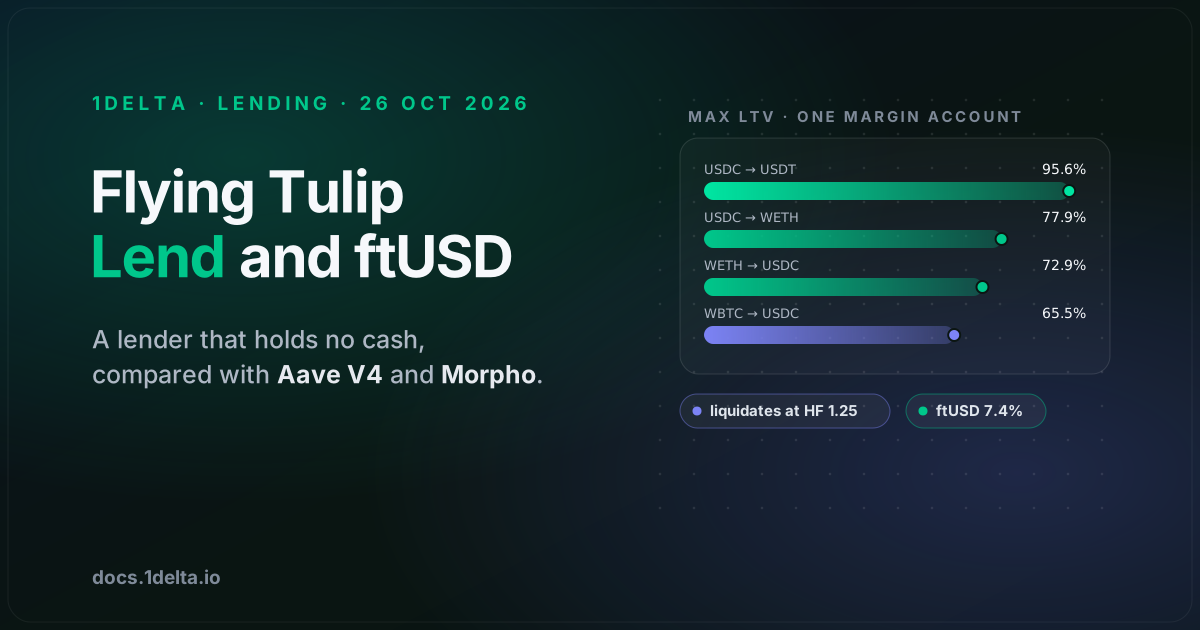
The maintenance rates on Ethereum today are 150 bps for USDC, USDT and ftUSD, 1700 for WETH, 2100 for wstETH and 2200 for WBTC. Because the margin is charged on the debt leg too, the loan-to-value you get depends on the pair. Solving the formula for the largest debt that keeps HF at the gate gives:
maxLTV(collateral i, debt j) = (1 − 1.50·mm_i) / (1 + 1.50·mm_j)
liqLTV(collateral i, debt j) = (1 − 1.25·mm_i) / (1 + 1.25·mm_j)
| collateral → debt | max LTV | liquidation LTV |
|---|---|---|
| USDC → USDT | 95.6% | 96.3% |
| WETH → USDC | 72.9% | 77.3% |
| WBTC → USDC | 65.5% | 71.2% |
| USDC → WETH | 77.9% | 80.9% |
| WETH → WBTC | 56.0% | 61.2% |
The 95.6% stable-against-stable figure is the highest we serve on any lender. It is also the reason ftUSD loops exist: ftUSD carries the same 150 bps margin as USDC.
The cross-margin model has a third input that is zero today. enginePnL is unrealised profit and loss from registered "engines", and when Flying Tulip's futures product ships, a user's perp PnL will feed the same equity that backs their loans. A health factor computed from collateral and debt alone will then be wrong, so integrators should read the protocol's own accountValues rather than rebuild it.
The docs describe something else. They describe an adaptive LTV that falls from 80% to 50% as volatility rises, computed from Flying Tulip's own spot liquidity, with soft, time-sliced liquidations and an LTV frozen at the moment you open. None of that is on-chain. Flying Tulip's roadmap lists it as a later milestone called Dynamic Lend. What runs today is the static margin table above.
Nothing sits idle
The second difference is where the money is. In Aave the pool contract holds the tokens, and cash nobody has borrowed sits there until a borrower or a withdrawer takes it. In FT Lend the PositionsManager holds no tokens. It keeps the ledger. Every asset has an ftYieldWrapper that custodies the balance, and each wrapper carries a list of strategies and keeps nothing idle. The same wrapper contract backs ftUSD: a dollar paid through MintAndRedeem lands in a wrapper of its own with its own strategy list. Lend and ftUSD are two front doors to one layer.
What those wrappers held on Ethereum at block 26277554 (26 October, 14:47 UTC). A wrapper's balance is the sum of every account's deposits in that asset after borrows, so the Lend WETH row is what is left after 676 WETH went out to borrowers, and the Lend wstETH row includes the 541 wstETH the strategy below posted as collateral:
| wrapper | balance | strategy | share |
|---|---|---|---|
| Lend USDC | 2.95M | Spark Savings USDC (spUSDC) | 100% |
| Lend USDT | 1.88M | Spark Savings USDT (spUSDT) | 100% |
| Lend WETH | 135.6 WETH | Spark Savings ETH (spETH) | 100% |
| Lend wstETH | 548.7 wstETH | none, held in the wrapper | |
| ftUSD USDC | 2.71M | Flying Tulip's delta-neutral strategy | 100% |
| ftUSD USDT | 1.95M | Flying Tulip's delta-neutral strategy | 100% |
The last two rows are the loop. The ftUSD wrappers list two strategies each, Spark Savings and a contract called MultiCollateralDeltaNeutralStakingStrategy, and every dollar is in the second. That strategy deposits the stablecoins into FT Lend as collateral under its own account, borrows WETH from Lend's suppliers, stakes it, and posts the wstETH back as more collateral. We traced the June funding transaction: a Spark withdrawal, a transfer to the strategy, a deposit into the PositionsManager, a WETH borrow, all in one block. On 25 October the strategy held 675 of the 676 WETH borrowed on Ethereum and 541 of the 549 wstETH supplied. ftUSD's backing therefore earns inside FT Lend: the in-kind supply rate on the stablecoins it posts, and a staking carry on WETH that other users deposited.
Three things follow from the wrapper layer.
- A withdrawal is a strategy unwind. A USDC withdrawal from Lend is a Spark Savings redemption underneath. An ftUSD redemption is an unwind of the ETH carry position. Aave never needs a circuit breaker on withdrawals because the cash is in the pool; Flying Tulip needs one because it is not (see the ftUSD section).
- Yield is routed through the treasury. Strategy income does not accrue to the wrapper's receipt token. It goes to Flying Tulip's treasury and comes back as FT to Lend suppliers, settled in epochs of about eight hours and weighted by how much each supplier held and for how long, and as discretionary payouts to ftUSD stakers. The epochs are on-chain (
PositionsManager.epochs(asset, id)records the FT paid out and the supply-time it was paid against), so the rate can be measured rather than taken from a page. - The strategies are chosen by the Safe. Nothing in the lending contract constrains what a wrapper may hold. The list is set by the same 3-of-5 Safe that sets the margins, with no timelock, and today it includes the protocol's own position.
On top of that, there is no reserve factor: the in-kind supply rate is exactly borrowAPR × utilization. We checked this against Flying Tulip's own front end on six Sonic assets and it matched to four decimals (USDC at 94.26% utilization and 10.76% borrow paid 10.14%).
The effect shows in the quotes. On Ethereum, Flying Tulip's API prices USDC at 3.70% to supply and 2.95% to borrow, USDT at 3.65% and 2.88%. A pool lender cannot pay suppliers more than its borrowers pay. This one can, because most of the supply rate is the FT stream. Measured over the last seven days of settled epochs and with FT at its market price, the stream alone came to 3.59% on Ethereum USDC and 10.22% on Sonic USDC.
That second leg is paid in a volatile token at the treasury's pace. FT trades at about $0.138; the protocol's own oracle carries it at $0.0936. Valued at the oracle price the same emission is a third smaller. That $0.0936 is also what FT counts for as collateral, which it now is (see below).
ftUSD
ftUSD is Flying Tulip's dollar. A user buys it 1:1 with USDC or USDT (on Ethereum also USDe, USDG and crvUSD) through the MintAndRedeem contract and sells it back the same way, paying 0.07% each way. The stablecoins go into the ftUSD wrappers described above. Flying Tulip names two yield sources for them, lending interest on stablecoins supplied to FT Lend and a delta-neutral strategy that borrows the chain's native asset against them, stakes it and keeps the staking yield net of the borrow cost. That is what the chain shows, with both sources inside FT Lend: the strategy's stablecoins earn Lend's in-kind supply rate, and its WETH is borrowed from Lend's other suppliers. CDP-style minting, a peg keeper and perp-funding carry are on the roadmap.
Those two sources are small next to what stakers are paid. Read at block 26277554 (26 October, 14:47 UTC), with balances from the PositionsManager, prices from Flying Tulip's own OracleRouter, borrow rates from its API and the stETH rate from DefiLlama:
| line | inputs | per year |
|---|---|---|
| supply interest on the strategy's USDC | 2,823,195 × 2.95% borrow × 12.5% utilisation | $10.4k |
| supply interest on the strategy's USDT | 1,948,893 × 2.88% × 11.7% | $6.6k |
| staking yield on its wstETH | 540.92 × $2,883.55 × 2.24% | $34.9k |
| borrow cost on its WETH | 675.95 × $2,311.93 × 1.73% | ($27.0k) |
| earned by the backing | on 4,683,582 ftUSD | $24.9k, or 0.53% |
| paid to sftUSD stakers | 2,334,203 × 6.01% | $140.2k |
| paid to ssftUSD stakers | about 612k (22 October size) × 7.14% | $43.7k |
| paid out | $183.9k, or 3.9% of supply |
The backing earns about one seventh of what is paid out. The rest is a treasury payout: strategy income goes to the treasury first, and the treasury also receives the Spark yield swept from Lend deposits and the yield on the FT sale proceeds, so the staking rate is a number Flying Tulip chooses each period rather than a rate the backing produces. These are snapshot figures annualised; utilisation, rates and prices move daily and the gap is a multiple, not a margin.
Plain ftUSD earns nothing. Yield goes to stakers, through two receipts:
| receipt | paid in | how |
|---|---|---|
| sftUSD | FT | rewards claimed separately, no compounding |
| ssftUSD | ftUSD | ERC-4626 vault, rewards vest into the share price |
The path from strategy to staker runs through the treasury. Net strategy yield and protocol fees land there and are passed on "via buyback-and-distribute at treasury discretion". The staking rate is a payout Flying Tulip chooses each period, backed by what the strategies earn, and there is no formula on-chain that ties the two together.
On Ethereum on 22 October:
| value | |
|---|---|
| ftUSD supply | 4.80M |
| staked as sftUSD | 2.41M, 6.31% APY |
| ssftUSD vault | 612k ftUSD, 7.43% APY |
| ssftUSD share price | 1.006811 ftUSD |
Sonic has 720k ftUSD with 553k staked at 9.66%, and BNB Chain $1.4k.
ssftUSD is the cleaner of the two. It is a standard ERC-4626 (StableEpochRewardsVault, verified on Sourcify) with 18-decimal shares over 6-decimal ftUSD. Flying Tulip funds a tranche of ftUSD every 8–16 hours and each tranche vests into the share price over 8 hours, so the price only goes up between tranches and never jumps. Its realized rate off archival convertToAssets was about 7.4% over the 20 days to 21 October, close to the 7.61% the API quoted then. Most of the vault's size arrived on 20 October, when a Morpho Blue market listing ssftUSD as collateral against USDC at 86% LLTV went live; before that the vault held about $13k.
The circuit breaker
Outflows from ftUSD pass a rate limiter, Circuit Breaker v2:
- the main buffer allows up to 5% of TVL out per 24 hours and refills linearly;
- an elastic buffer grows with fresh deposits and decays over 30 minutes, so a deposit cannot be used to drain the main buffer in the same block;
- TVL for the calculation is floored at
minTVLForMint= 500,000 ftUSD, which keeps a minimum 25,000 ftUSD of daily room when supply is small; - anything over capacity is queued for a settlement delay (6 hours today, configurable from 5 minutes to 7 days) and paid by anyone who calls
executeQueuedafter it; - deposits are never limited, and if the breaker itself malfunctions, it lets transactions through.
For ssftUSD the breaker shows up differently. The vault redeems synchronously out of the yield wrapper, and if the breaker would hold the payout, the redemption reverts instead of joining the queue. A holder who needs to exit during a run either waits for capacity or sells on the ftUSD/USDC pool.
FT and the perpetual put
FT is where the second supply yield comes from, so its design matters for lenders. The public sale priced FT at 10 FT per dollar, $0.10, from a fixed supply of 10 billion. Each sale position is an ftPUT NFT that lets its holder hand back the FT and receive the exact asset and amount they paid, for as long as they hold the position. The raised money sits in low-risk positions (Aave stablecoin supply, stETH, jupSOL, sUSDe), and its yield funds development first and buys back and burns FT with the remainder. A holder who withdraws FT from the put gives up the exit for good, and the backing that portion reserved funds more buybacks.
FT bought on the market carries no put, and neither does FT paid out as supply yield. With FT at $0.138 the sale buyers' strike sits below the market, so the floor is out of the money for them too.
FT as collateral
When we first read FT Lend in August, FT was listed with collateral: false and a margin of zero. On 23 October the lens shows it as collateral, not borrowable, with a 6000 bps maintenance margin. Under the gates above that lets FT back borrowing at 10% of its value to open and 25% at liquidation. Its supply cap is 4.75M FT and 4.70M are already deposited.
The price it is valued at has not moved. The OracleRouter returned exactly $0.0936 at every block we sampled between 11 September and 26 October, while FT traded between $0.137 and $0.145. The router's implementation is not verified, so we cannot read how or whether that mark updates. A fixed mark a third below the market is conservative while FT stays above it. For as long as it stays fixed, a position backed by FT cannot be liquidated on an FT price move: it stays healthy at $0.0936 whatever FT trades at, and any shortfall would land on the lenders.
Because FT Lend has one configuration per chain, that exposure is shared. On Ethereum USDC, USDT, ftUSD and sUSDe are all borrowable, and all of them can now be borrowed against FT. A looper who posts sUSDe and borrows ftUSD never touches FT. Their sUSDe can still be lent to someone who posted FT. In an isolated design the same collateral would put only its own market's lenders at risk.
The exposure is small and capped. At the oracle mark the full cap is worth about $444k, which unlocks about $44k of borrowing to open and $111k at liquidation, against roughly $23M supplied. In the simplest case, ignoring borrow availability and the cost of acquiring FT, borrowing against it only pays once FT is worth less than the borrowing it unlocks, about $0.0094, 93% below today's price. What keeps it small is the cap and the margin. Both sit with the same Safe that set them, so it could widen in one transaction.
Leverage through signed orders
FT Lend has Aave-style credit delegation (approveBorrow), but the only functions that spend it are reserved for registered engines, and only Flying Tulip's Safe can register one. An outside contract such as our composer therefore cannot borrow or withdraw for a user, and the plain one-shots (deposit-and-borrow, repay-and-withdraw) take two transactions.
Leverage runs through the LeverageRfqEngine. The user signs a LeveragedOrder (or pre-signs it on-chain), and anyone can fill it: the engine borrows exactly the signed amount on the user's account, the filler swaps it, and the engine checks that at least the signed amount of collateral arrived and the health factor holds. The swap target is not allowlisted. Borrowing against an account needs two things from its owner, the borrow allowance and a signed order for the exact fill, so a third party holding a resting order can only execute it at the user's bounds.
Flying Tulip's own Trade product, live on Sonic since August, is this path with their filler bot on the other side and KyberSwap doing the swap. We fill the same orders on Ethereum with a Morpho flash loan inside our composer, and the user grants nothing to any 1delta contract: both grants go to Flying Tulip's engine, sized to the one order and used up by the fill.
Liquidations
The liquidation engine is a separate contract, the RfqEngine, verified on Ethereum. Anyone can call it against an ordinary account once its health factor is under 1.25. A liquidator names the debt it will repay and the collateral it wants, the engine withdraws the collateral first, runs an optional callback so the liquidator can sell it, then pulls the repayment. Three rules shape the fill:
- Partial, inside the corridor. The repayment is capped at what lifts the account back to HF 1.50 and the fill reverts if it lands above that, so a liquidator can only trim a position back into the 1.25 to 1.50 band. A full close is allowed when the remainder would be dust.
- A fixed bonus. Seized collateral may not exceed the repaid debt times 1.075. The protocol keeps 10% of the realized bonus, so a liquidator nets up to 6.75%. On Ethereum a fill must repay at least $100 and leave no residual under $250.
- Bad debt stays with lenders. Once equity is zero and the collateral is gone, the engine accepts a pure repayment to clear the account. There is no insurance fund or shortfall module in the path, so unrepaid debt remains on the asset's books.
The record so far is small. Sonic has seen 97 liquidations between 16 August and 17 October 2026 across 19 accounts, repaying $3,835 in total and seizing $4,122, a realized bonus of 7.47%. The median fill repaid $3. Every one was executed by the two liquidator contracts the Flying Tulip Safe whitelisted. Ethereum has had none since the engine was registered on 28 April. On 25 October no account on either chain sat below 1.25; two on Ethereum and six on Sonic were in the band.
One account on each chain is marked privileged, which means only a Safe-whitelisted liquidator may touch it, and the lens reports its maintenance requirement as zero, which means a liquidation reverts before it starts. Both are Flying Tulip's own delta-neutral strategy, registered in the ConfigRegistry as a DNMM strategy:
| Ethereum | Sonic | |
|---|---|---|
| collateral | $2.82M USDC, $1.95M USDT, 541 wstETH | $721k USDC, 27.4M stS |
| debt | 675 WETH, about $1.62M | 29.4M wS, about $1.54M |
| share of the chain's debt | 34% | 41% |
| share of that asset's borrow book | 99.9% of WETH debt | 97% of wS debt |
| who may liquidate it | the Safe itself, on the newer of two engines | the two whitelisted liquidators |
WETH suppliers on Ethereum are therefore lending almost entirely to Flying Tulip's own ETH carry trade, which borrows at 1.73% and pays them 1.68%. The strategy also holds 98.6% of the wstETH supplied on the chain. Its USDC and USDT are ftUSD's backing, routed in through the wrappers above.
The docs describe soft, time-sliced liquidations routed through Trade and paid keepers. What runs is a single-clip flash liquidation at a fixed bonus, the same gap as the adaptive LTV.
Compared with Aave V4 and Morpho
Aave V4 and Morpho Blue are the two designs every new lender gets measured against. Aave V4 pools liquidity in a Hub and puts risk in Spokes, each spoke a market with its own collateral rules and oracle; a user's borrow rate adds a premium that depends on the quality of their collateral, and risk parameters are versioned so that existing positions keep the configuration they opened under until refreshed. Morpho Blue is an immutable core of isolated markets, each fixed at creation to one loan token, one collateral, one oracle, one rate model and one liquidation LTV, with vaults on top that allocate deposits across markets.
| Flying Tulip Lend | Aave V4 | Morpho Blue | |
|---|---|---|---|
| where the tokens are | in per-asset wrappers, 100% deployed to strategies, one of them FT Lend itself | in the hub | in the market |
| unit of risk | one cross-margin account per user | user position on a spoke | one isolated market per pair |
| liquidity | one pool per asset per chain | shared hub, drawn by spokes | per market, pooled by vaults |
| risk parameter | maintenance margin on collateral and debt | collateral factor per reserve, plus a per-user risk premium on the rate | liquidation LTV per market |
| stable-vs-stable max LTV | 95.6% (pair-dependent) | per spoke | set by the market's LLTV (e.g. ssftUSD/USDC at 86%) |
| liquidation trigger | HF < 1.25 | HF < 1 | LTV > LLTV |
| liquidation bonus | fixed 7.5%, 10% of it to the protocol | variable, up to the reserve's maximum | fixed per market by its LLTV |
| supply yield | borrow × util (no reserve factor) + FT from the wrappers' strategies, via the treasury | borrow interest less reserve factor | borrow interest; vault fee on top |
| acting for a user | engine-gated, admin-registered | governance-whitelisted position managers, opted into per user | any address the user authorises |
| leverage | signed orders, open fill, unrestricted swap target | through position managers | flash loans plus a bundler or callbacks |
| upgrades | UUPS proxies, 3-of-5 Safe, no timelock | governance with timelocks, plus a guardian for emergency pauses | core immutable |
| public audit of the lending code | none found | multiple | multiple, plus formal verification |
Where the money is. Aave V4 and Morpho hold the tokens, so a withdrawal depends on the pool's own liquidity, within whatever caps and pauses its governance has set. FT Lend holds none: every balance is in a wrapper that is fully deployed, so a supplier's exit depends on Spark giving the cash back, and an ftUSD holder's exit depends on an ETH carry position inside FT Lend unwinding. The wrapper layer is also where the protocol's own position lives, so the lending book, the stablecoin and the treasury's trade share one balance sheet.
How collateral is weighed. Morpho prices risk per pair and Aave V4 per spoke, so one bad collateral stays inside its market or spoke. FT Lend nets everything in one account, and every collateral it accepts can borrow every borrowable asset on the chain: listing FT as collateral reached every lender on Ethereum at once. That gives the highest stable-against-stable LTV we list and lets a hedge offset its own debt, and it puts every asset a user holds, and soon every futures position, behind the same liquidation line.
Who can change the rules. Morpho Blue's core cannot change. Aave V4's parameters change through on-chain governance with delays, and a guardian can pause in an emergency. FT Lend's parameters, oracle and implementation change through one Safe in one transaction. Since August the PositionsManager implementation has been replaced twice (0xe0D676a6… → 0xfB2D54Ac… → 0x89b6f917…), the minimum account equity on Ethereum has gone from $250 to $0 while Sonic stayed at $10, and FT itself has become collateral at a fixed price. None of them appears in the docs or in the blog's August, September and October updates.
Before you put money in
- Governance. Every core contract is a proxy behind a 3-of-5 Safe with no timelock. The
ConfigRegistryimplementation, which holds the margins, caps, pauses and both health-factor gates, is still not verified on Sourcify. - Audits. The public Sherlock contest covered the ftPUT and token contracts. We have not found a published audit of the lending stack, and the docs' audits page returns 404.
- Liquidations. Anyone can liquidate an ordinary account, at a fixed 7.5% bonus, inside the 1.25 to 1.50 corridor. The protocol's own delta-neutral strategy is exempt: it carries a third of Ethereum's debt and 99.9% of its WETH debt with a maintenance requirement of zero.
- The FT leg. Supply yield on Ethereum is mostly FT at the treasury's pace and the market's price.
- The protocol's own book. Each chain has one unliquidatable account, Flying Tulip's delta-neutral strategy. It is the largest borrower on both, and on Ethereum it is where all of ftUSD's backing sits.
- FT collateral. Every lender on Ethereum is indirectly exposed, through the shared pool, to borrowing against FT valued at a fixed $0.0936. That is about $44k of borrowing today, bounded by FT's supply cap.
- Exits under stress. No cash sits in the lending contract. A Lend withdrawal is a Spark redemption, an ftUSD redemption is a carry-trade unwind. ftUSD outflows are capped at 5% of TVL a day before queuing, and ssftUSD redemptions revert while the breaker holds.
- Futures. When
enginePnLgoes live, lending health will move with perp PnL.
What 1delta supports
Flying Tulip is integrated as the FLYING_TULIP lender on Ethereum, Sonic and BNB Chain:
- Data: every listed asset with in-kind supply and borrow rates, caps, pauses and per-pair LTVs derived from the live margins, all from Flying Tulip's lens with no API dependency. User positions carry the protocol's own equity, maintenance and health factor. The FT emission is being added as a separate reward stream valued at FT's market price, so the published supply rate stops being a floor.
- Actions: deposit, withdraw, borrow and repay as direct transactions, including native ETH in and out, and deposit-and-borrow and repay-and-withdraw as two-step flows.
- Loops: open and close on Ethereum through Flying Tulip's leverage engine. BNB Chain runs a newer engine we have not proven yet, so loops there are refused.
- Earn: ssftUSD as a savings vault, and the ssftUSD/USDC Morpho market through our Morpho integration.
Our risk scoring marks every Flying Tulip pair on Ethereum high (5), including stablecoin carries such as sUSDe → ftUSD whose own legs score low. A pair's score includes every collateral in its configuration, and FT's fixed-price oracle scores 5. Those loops are hidden under a default risk ceiling of 4 and shown when the ceiling is raised.
Every Flying Tulip row carries a term sheet that states the 1.25 liquidation line, the 1.50 open gate and that the quoted rate excludes the FT emission. For the other side of the comparison, see how Fluid shares one liquidity layer across its markets and how we aggregate lending across all of them.
Sources: on-chain reads on Ethereum and Sonic of the Flying Tulip PositionsManager (0xbe4050a73a7Fb384c65E885a15C33461A4B20055, implementation 0x89b6f9179671C0B471734B897E31F8760a94dc53), LendingLens (0x3682168023E6bA8D1F995FdA1D920827C5A8A43E), ConfigRegistry (0xA8777c3D446fa7F0b0FC97a80C1Ea1d37F1ca33E), AccountValuesLens (0x7aD77FddEf64Ec8325E8d2d02c2708AA2a412eF7), OracleRouter (0xe4372dB43D2814750a19b93950157AD81D93674A), ftUSD (0xF7D85EC4E7710f71992752eac2111312e73E9C9C) and ssftUSD (0x23212884…), 22 October 2026; FT's assetCfg, priceAndDecimals, supplyCap and assetState on Ethereum, 23 October 2026; the FT oracle mark sampled at blocks 25955804 through 26277554; RfqEngine (0xEB00B335Ca52216Fb60fdFFA361397367C39Dc32 and the proxy 0xC64516d58f8B83BC256448BC69D7Bf2361557fDB) parameters, fill events and per-account accountValues on Ethereum (block 26255649) and Sonic (block 81506069), 25 October 2026; Lend and ftUSD ftYieldWrapper balances and strategy lists on Ethereum at block 26277554, 26 October 2026, the delta-neutral strategy 0xe0E445967256EE60111e243e0F0F94DD1D351A59 and its funding transaction 0xe3506af103a3f765cdfe1fa161779dd74cf52b76e214624182c134cd8a44c444 of 15 June 2026; FT market price and the stETH rate from DefiLlama; Flying Tulip API (/ftusd/overview, /mm/lend); Flying Tulip docs (Capital Allocation, Circuit Breaker v2, Glossary) and the Flying Tulip blog updates for August, September and October 2026.